

There’s a reason people who find Cedar Key never really leave it behind. Maybe it’s the way State Road 24 just… ends here, with nothing but water on three sides. Maybe it’s the lack of high-rises, traffic lights, or chain restaurants. Or maybe it’s that this tiny island town on Florida’s Gulf Coast still moves at the pace it did a hundred years ago: slow tides, slower mornings, and fish that haven’t learned to be afraid of boats yet.
If you’ve never heard of Cedar Key, you’re not alone. It’s not on the way to anywhere. You have to mean to come here. And that’s exactly what makes it one of the last true “Old Florida” fishing towns left on the Gulf Coast.
This guide will walk you through what makes Cedar Key special, a little of its surprisingly rich history, and why it deserves a spot on every angler’s list, whether you’re chasing your first redfish or your fiftieth.
Where Exactly Is Cedar Key?
Cedar Key sits at the southern end of Florida’s “Big Bend” region, about three miles off the mainland in Levy County, roughly halfway between Tampa and Tallahassee on the state’s Nature Coast. It’s actually a cluster of small islands, with the town itself built mostly on Way Key. The whole place covers barely two square miles of land, surrounded by a maze of grass flats, oyster bars, mangrove channels, and barrier islands that stretch out into the Gulf of Mexico.
There are no interstates here. No big box stores. Just a two-lane highway that carries you past pine forest and salt marsh until the road runs out and the town begins.
A Town Built on Cedar, Saved by Fish
Cedar Key didn’t start as a fishing town; it became one. In the mid-1800s, the area was a booming hub for the cedar timber trade, shipping wood north to pencil factories. By the 1860s, Cedar Key was even the western terminus of Florida’s first cross-state railroad, hauling cotton, lumber, and goods between the Gulf and the Atlantic coast. For a while, it was one of the largest towns in Florida.
Then nature stepped in. A massive hurricane in 1896 flattened much of the original settlement on nearby Atsena Otie Key, and within a decade or two, the cedar supply itself ran out. The town could have disappeared. Instead, it leaned into what had always surrounded it: the water.
Fishing, oystering, and sponge diving became the new economy. By the early 1900s, Cedar Key had reinvented itself as a seafood town, and in many ways, it never stopped being one. Today the area is one of the largest producers of farm-raised clams in the eastern United States, and the working waterfront still smells like salt, diesel, and fresh catch every morning.
In 1929, President Hoover designated several of the surrounding islands as the Cedar Keys National Wildlife Refuge, protecting one of the most important bird nesting habitats on the Gulf Coast. That same wild, undeveloped character, the one that makes the birds want to stay, is exactly what keeps drawing anglers back, generation after generation.
What Makes Cedar Key Different From Every Other Florida Fishing Town
If you’ve fished the more popular spots in Florida, places like Destin, Naples, or the Keys, Cedar Key is going to feel like stepping into a different state entirely.
It’s quiet. There’s no jet-ski traffic buzzing past your spot. No line of boats at every honey hole. The flats here see a fraction of the pressure that busier parts of Florida deal with, which means the fish behave like fish are supposed to, not like fish that have been chased by forty boats since sunrise.
It’s shallow, wild, and maze-like. The waters around Cedar Key are dotted with dozens of small islands, oyster bars, and grass flats that only a local captain really knows how to read. Low tide can leave whole sections of water just inches deep, which is exactly the kind of water that holds redfish, trout, and sheepshead tight to structure.
It’s still a working town. This isn’t a manufactured tourist destination. The same docks that load up charter boats also load up commercial clam and oyster boats. The seafood you eat for dinner on Dock Street was probably pulled out of the water that same morning, often by someone whose family has been doing it for generations.
It’s genuinely historic. The whole town and surrounding area is part of the Cedar Keys Historic and Archaeological District, recognized on the National Register of Historic Places. Native peoples used these waters as fishing grounds going back thousands of years, and naturalist John Muir famously passed through in 1867 on his walk to the Gulf, writing about being struck by the sheer expanse of water after a life spent in the forest. You’re fishing the same flats people have fished for centuries; that’s not something you can say in most places anymore.
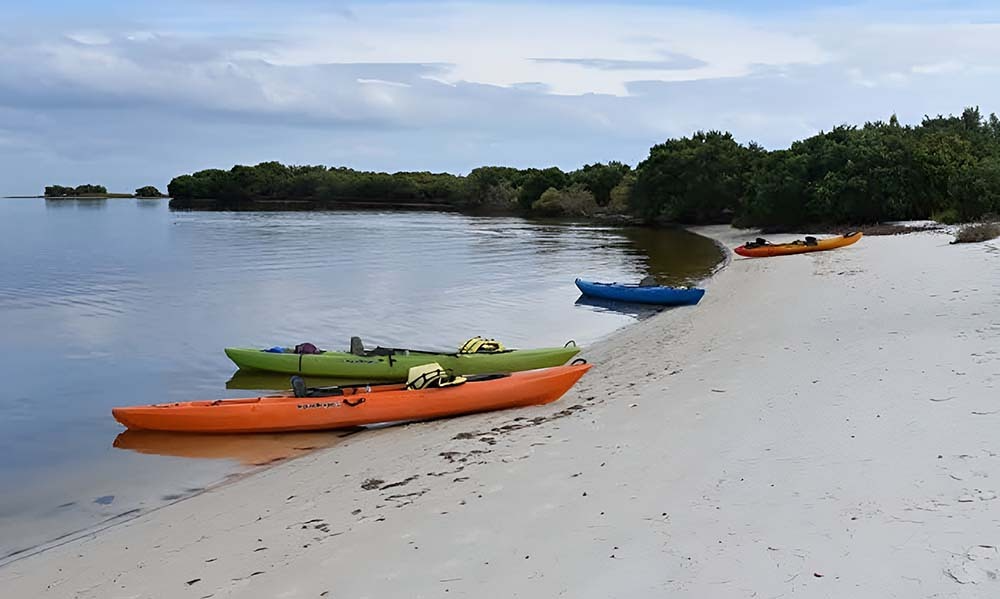
A Captain Who’s Been Doing This Since Before “Old Florida” Was a Marketing Term
Saltwater Outlaw Charters was started in 1992 by Captain Tracy Collins, a fourth-generation Cedar Key native. Tracy didn’t learn to fish Cedar Key from a guidebook; he learned it from his uncle, Edgar “Yellow Legs” Campbell, a local legend who spent nearly seven decades working these waters as a commercial fisherman and guide before he passed in 2000.
That’s the kind of knowledge that doesn’t show up on a chart. Knowing which oyster bar holds fish on a falling tide in October versus April; knowing where the bait pushes when a front comes through; knowing which channel still has water in it when everything around it goes dry that’s generational knowledge, passed down rod to rod.
It’s also the kind of local insight that turns a fishing trip into something more. Past guests have talked about how much they learned about Cedar Key’s history, legends, and marine science along the way, proof that a good charter captain here is part guide, part storyteller, and part marine biologist.
What to Expect When You Visit
Cedar Key isn’t going to overwhelm you with options, and that’s the point. A typical day might look like:
- An early start on the water, chasing redfish, trout, sheepshead, or whatever’s biting that season
- A break to wander Dock Street, the historic old waterfront lined with seafood restaurants, local art galleries, and weathered buildings that have stood for over a century
- Fresh local clams or oysters for lunch; Cedar Key practically invented the farm-raised clam industry on the East Coast
- An evening watching the sun drop into the Gulf with absolutely nothing blocking the view
If you time your visit right, you might catch one of the town’s signature events, the Cedar Key Seafood Festival every October, or the Old Florida Celebration of the Arts in the spring. Both draw crowds, but even at its busiest, Cedar Key never quite loses that small-town, unhurried feel.
Why Anglers Keep Coming Back
Ask anyone who’s fished Cedar Key more than once, and you’ll hear some version of the same thing: it gets in your blood. It’s not flashy. There’s no marina full of mega-yachts, no boardwalk of souvenir shops. What there is, instead, is some of the most productive and least-pressured inshore fishing left on Florida’s Gulf Coast, paired with a town that genuinely hasn’t sold its soul to tourism.
For families, it’s a place where kids can learn to fish the way it used to be taught, patiently, on the water, from someone who actually knows the place. For serious anglers, it’s a shot at quality fish in waters that haven’t been hammered. And for everyone, it’s a rare chance to experience a slice of Florida that mostly doesn’t exist anymore.
Ready to Experience It Yourself?
Cedar Key isn’t a place you stumble into; it’s a place you decide to visit. And once you do, you’ll understand why a fourth-generation local captain still calls it the best home water in Florida.
If you’re planning a trip, explore our half-day, 3/4-day, and full-day charter options to find the trip that fits your group, or get in touch with Captain Tracy directly to start planning your day on Cedar Key’s waters.
Frequently Asked Questions
Q: Where is Cedar Key, Florida, located?
A: Cedar Key sits on Florida’s Gulf Coast in Levy County, at the southern end of the “Big Bend” region, about three miles offshore from the mainland and roughly halfway between Tampa and Tallahassee at the end of State Road 24.
Q: Why is Cedar Key called “Old Florida”?
A: Cedar Key is called “Old Florida” because it has avoided the high-rises, chain stores, and heavy development found in most of the state’s coastal towns. The historic downtown, working seafood docks, and slow island pace reflect what much of Florida’s Gulf Coast looked like generations ago.
Q: What is Cedar Key known for?
A: Cedar Key is known for its rich seafood industry (especially farm-raised clams and oysters), historic 19th-century downtown, the Cedar Keys National Wildlife Refuge, and excellent inshore saltwater fishing for redfish, trout, and sheepshead.
Q: Is Cedar Key good for fishing?
A: Yes. Cedar Key is considered one of Florida’s top inshore fishing destinations, thanks to its shallow grass flats, oyster bars, and mangrove channels that hold redfish, speckled trout, sheepshead, black drum, cobia, and seasonal snook and tripletail with far less fishing pressure than busier parts of the state.
Q: How far is Cedar Key from major Florida cities?
A: Cedar Key is about a 1.5 to 2-hour drive from Gainesville, roughly 2.5 hours from Tampa, and around 2.5 to 3 hours from Tallahassee, making it an easy day trip or weekend getaway from North and Central Florida.
Q: What’s the best way to experience Cedar Key’s fishing?
A: The best way to experience Cedar Key’s fishing is with a local, experienced charter captain who knows the tides, flats, and seasonal patterns. A guided trip with a multi-generation local captain like Tracy Collins gives visitors access to spots and knowledge that aren’t possible to find on your own.
Q: Is Cedar Key family-friendly?
A: Yes. Cedar Key is a relaxed, low-key island town that’s well suited to families, with calm inshore waters for fishing, a small historic downtown to explore, local seafood restaurants, and charters that welcome beginners, kids, and even well-behaved pets.
Saltwater Outlaw Charters, Cedar Key, FL | Captain Tracy Collins | 352-843-4067
